Your local agent workspace.

Less juggling. More building.

Schedule your agents. Review their work. Keep the decisions yours.

Free for one project. Pro is $89, once — no subscription and no server to fund.

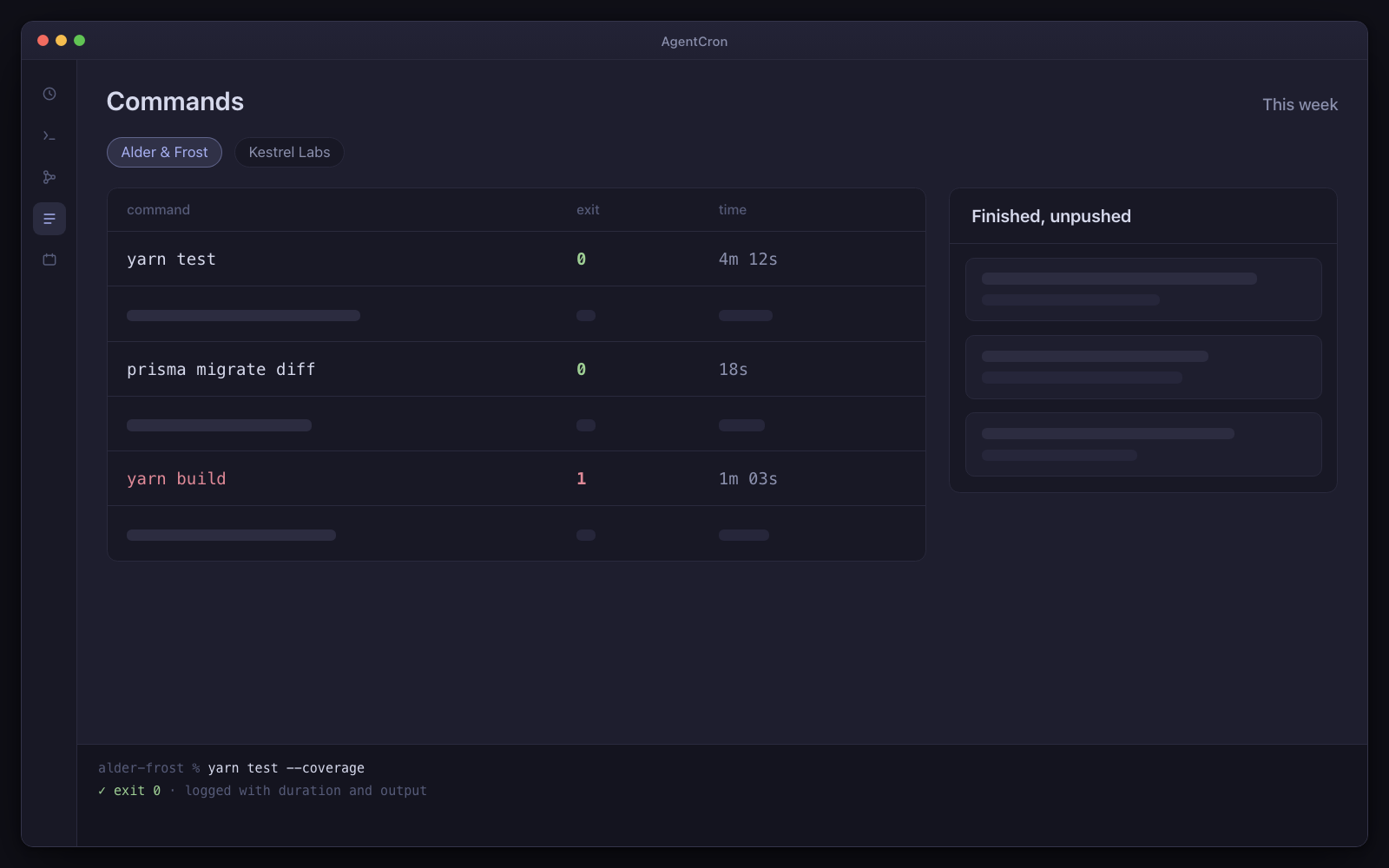
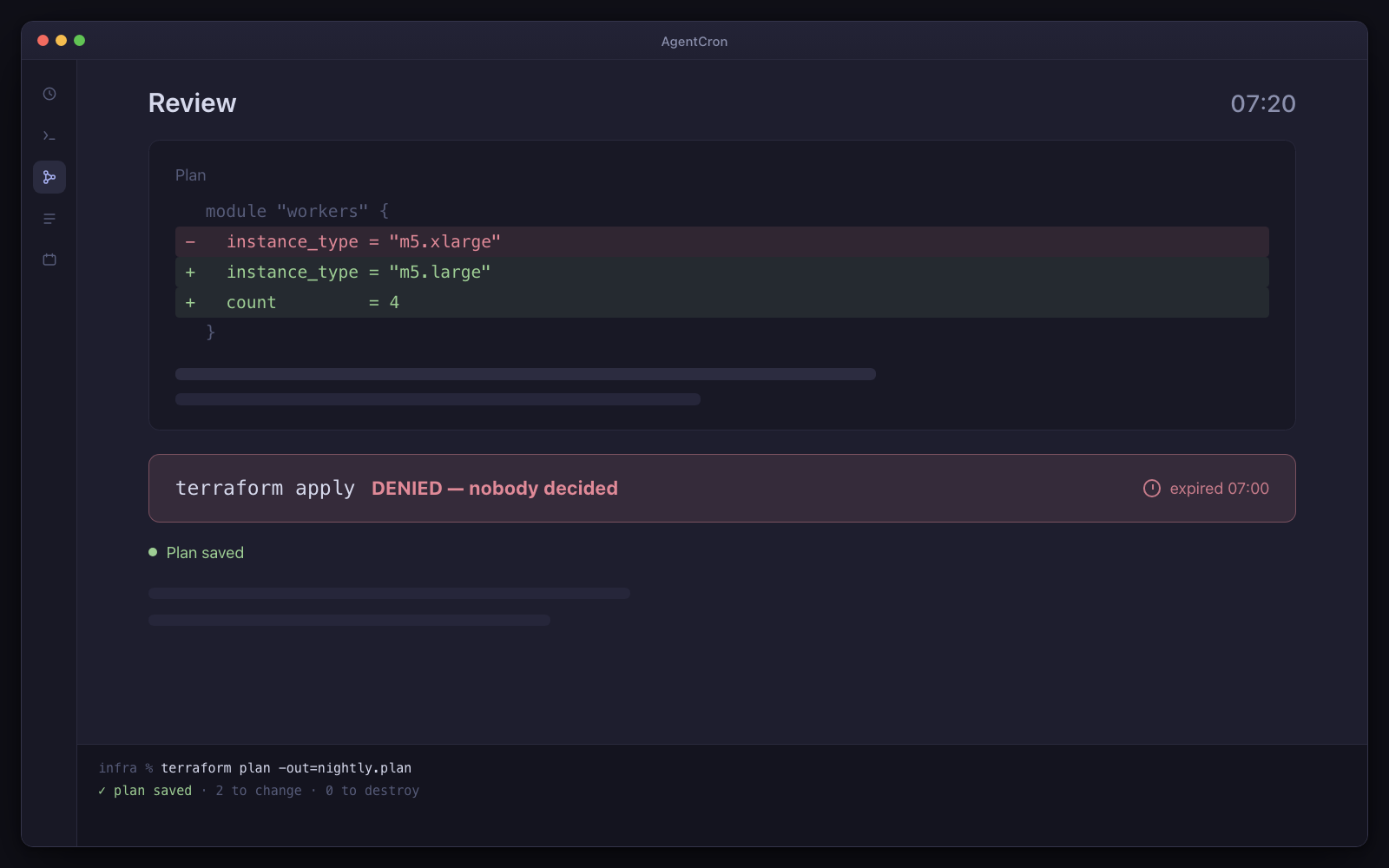
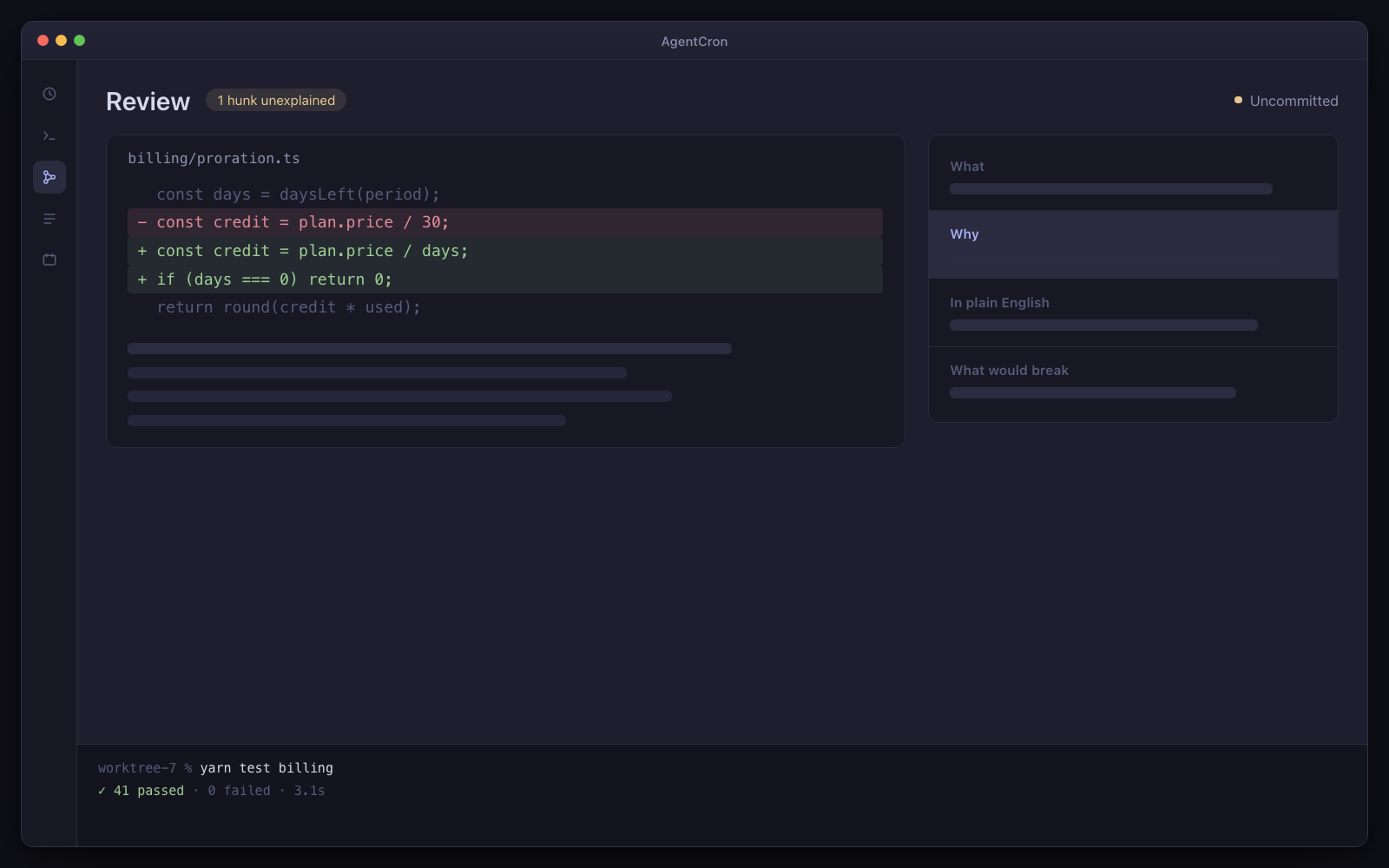
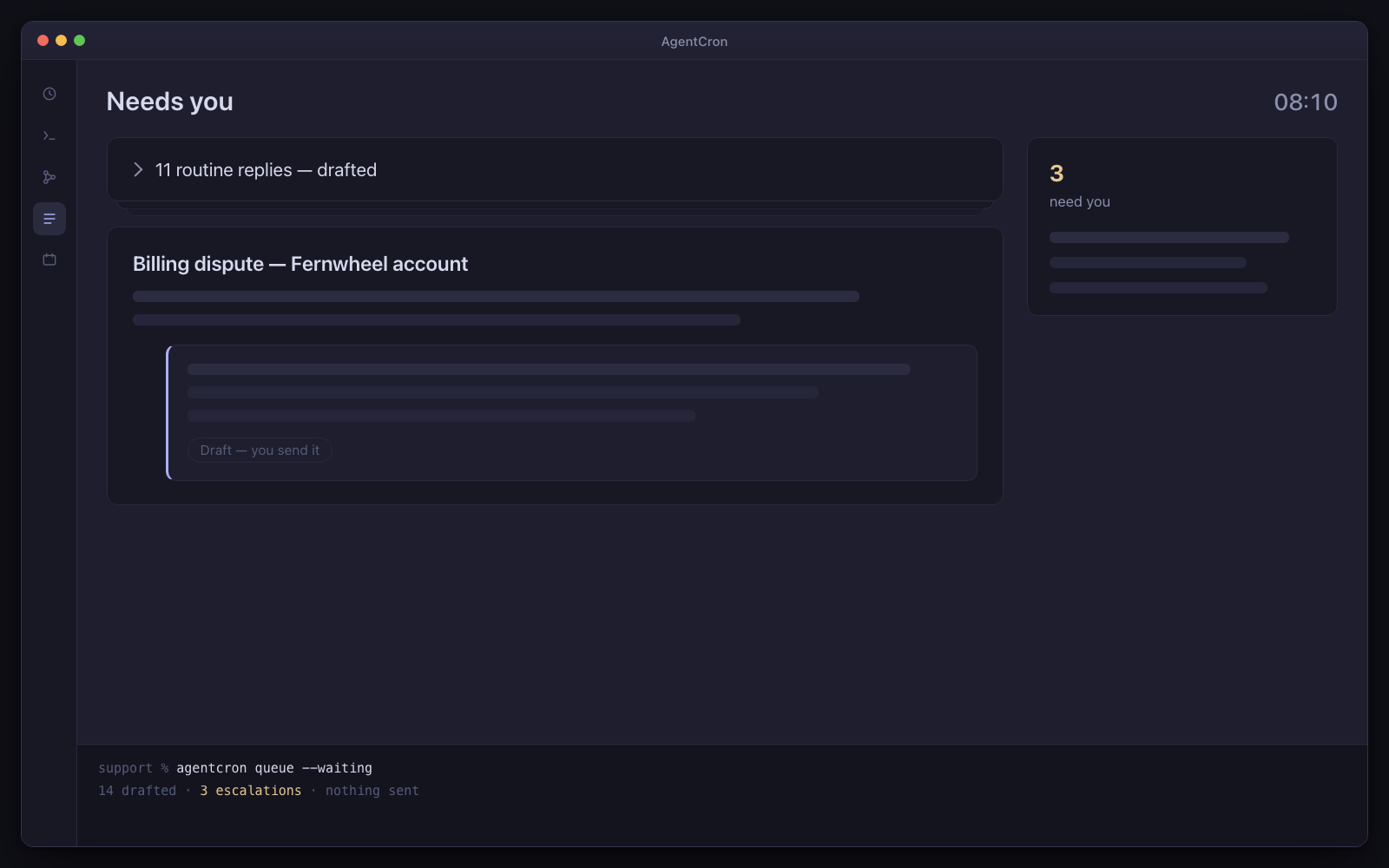
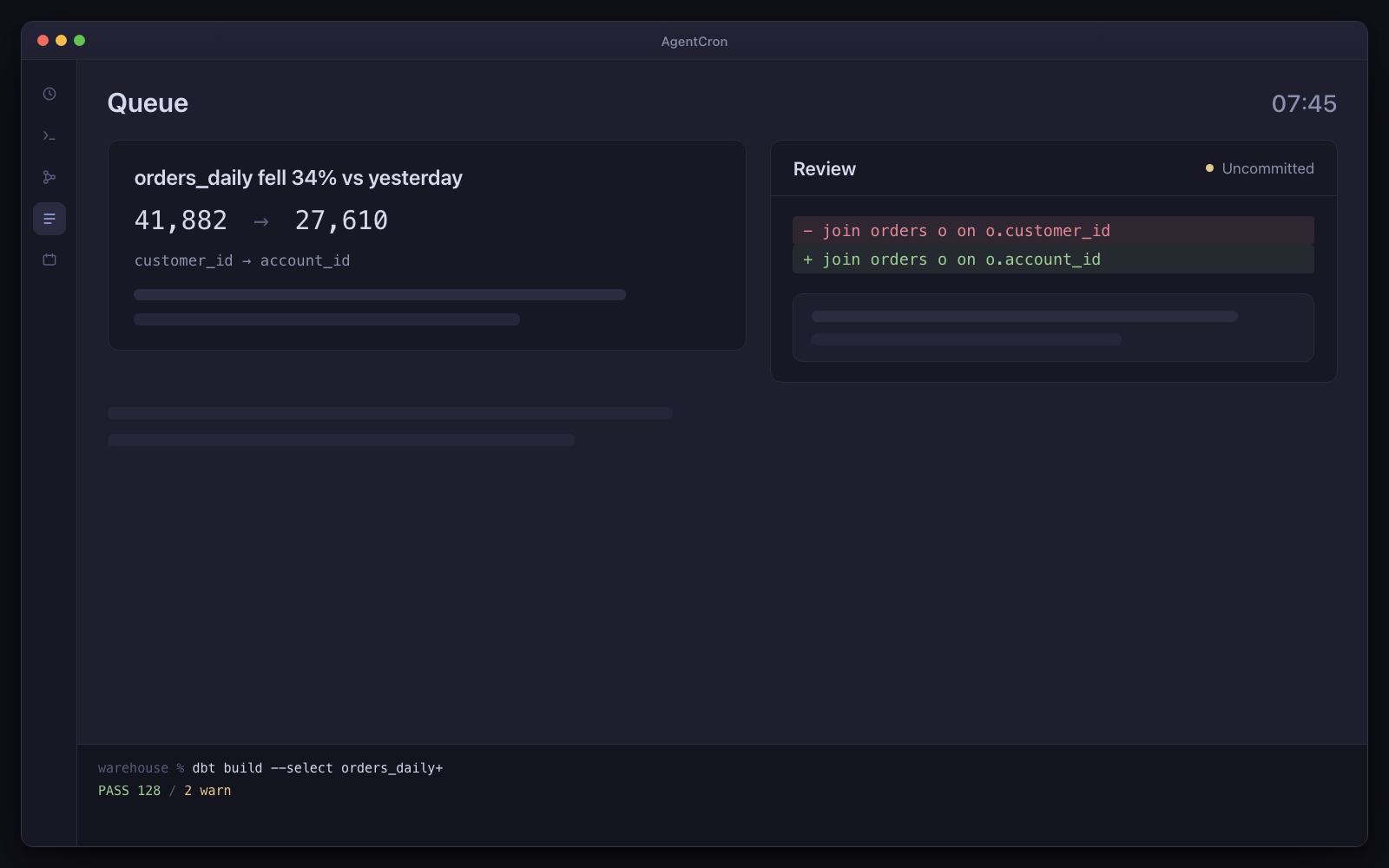
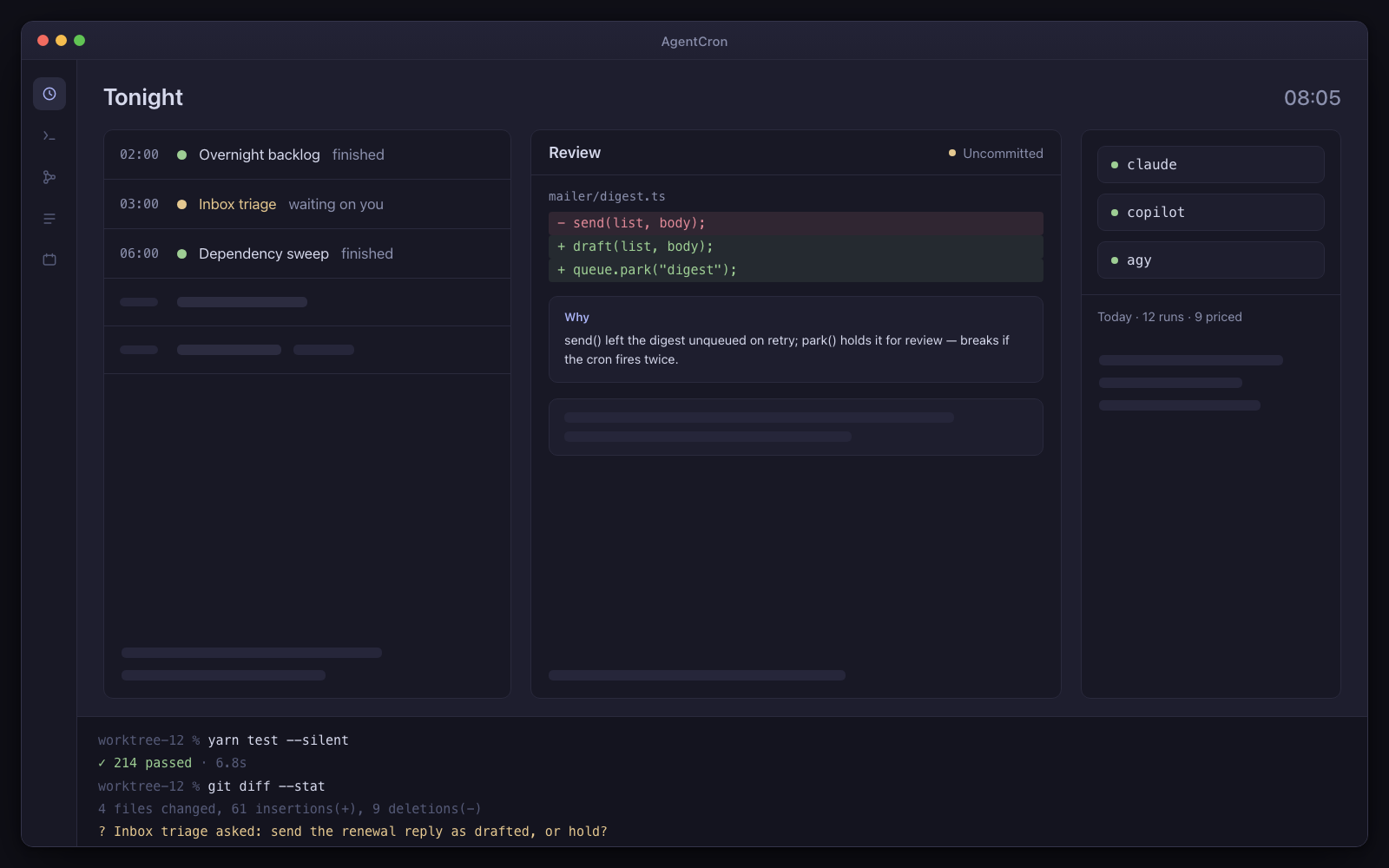
The AgentCron window: a schedule of five agents — two finished, one waiting on you — a review panel holding an uncommitted diff with its explanation card, pills for the three CLIs with a cost line under them, and a live terminal session along the bottom.
Illustration Your morning control room: scheduled runs, an uncommitted diff, and a question waiting for your decision.
  • You bring the CLIUse the agent subscription you already have. No AgentCron API key, account or token meter.
  • Human review is the destinationRuns return work and records for you to inspect. Where a workflow uses AgentCron's approval command, denial, timeout or an unreachable app all fail closed.
  • Runs locally, leaves receiptsYour schedules and app records stay on your Mac. Connected CLIs and services keep their own network and data policies.

Drives the agent CLIs you already pay for

  • Codex CLIcodex
  • Claude Codeclaude
  • GitHub Copilot CLIcopilot
  • Antigravityagy
  • Plain shellshell

You bring the CLI and its subscription. AgentCron schedules the run, keeps its output, and shows the command evidence that integration can capture.

What kind of work keeps returning?

Choose the closest role. Three audience packs are bundled; the other seven starting sets are assembled from the included picker templates. Every page says which is which.

Content creator

Monday morning: the week planned, the drafts written, the posts queued. You publish.

The calendar going empty is what kills a channel, and it goes empty in the weeks you are busiest. This does the planning and the first drafts overnight, so you sit down to edit rather than to start.

Not released yet. It will need macOS 12.0 or later on Apple Silicon — and the download page says exactly what is still missing.
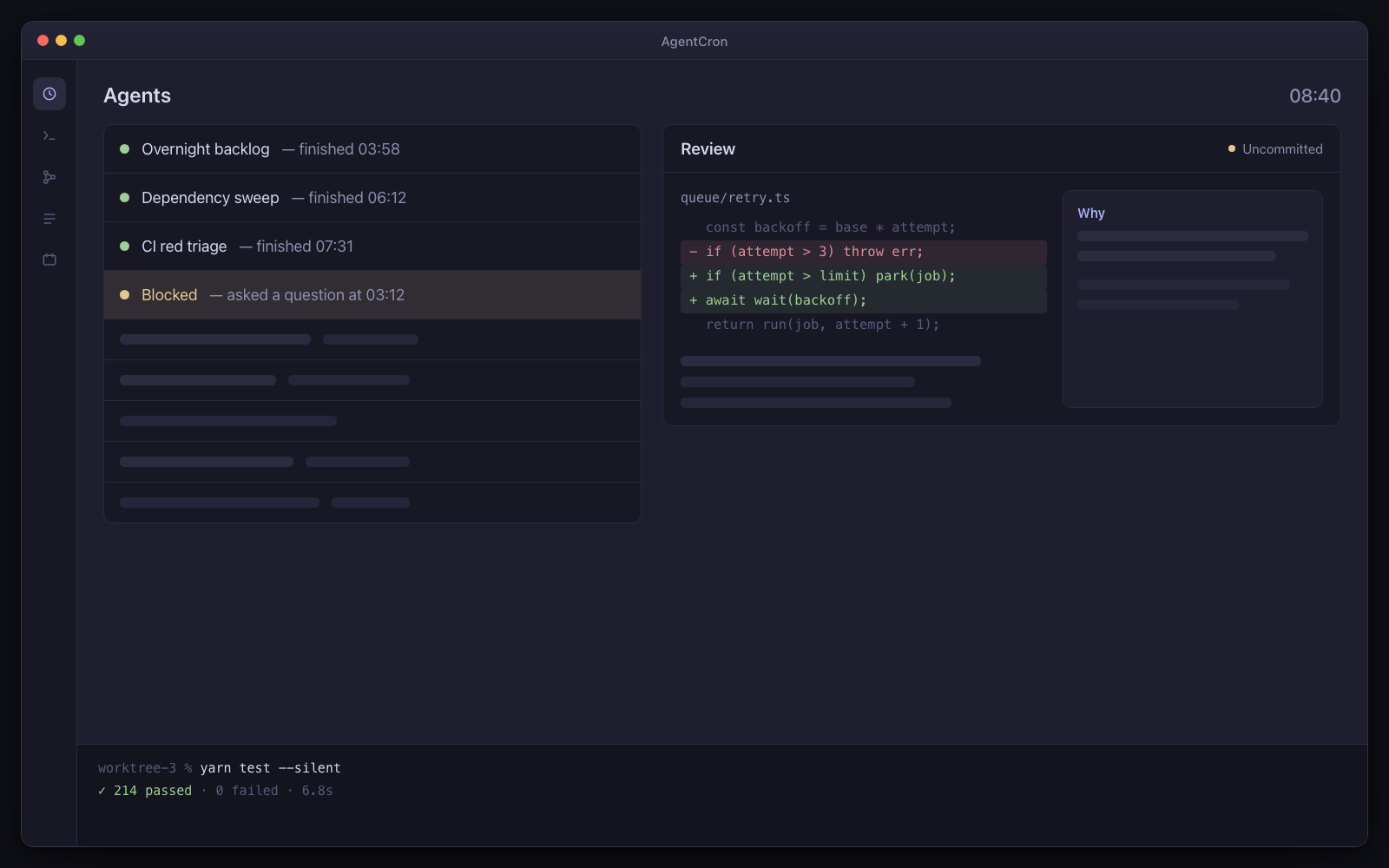
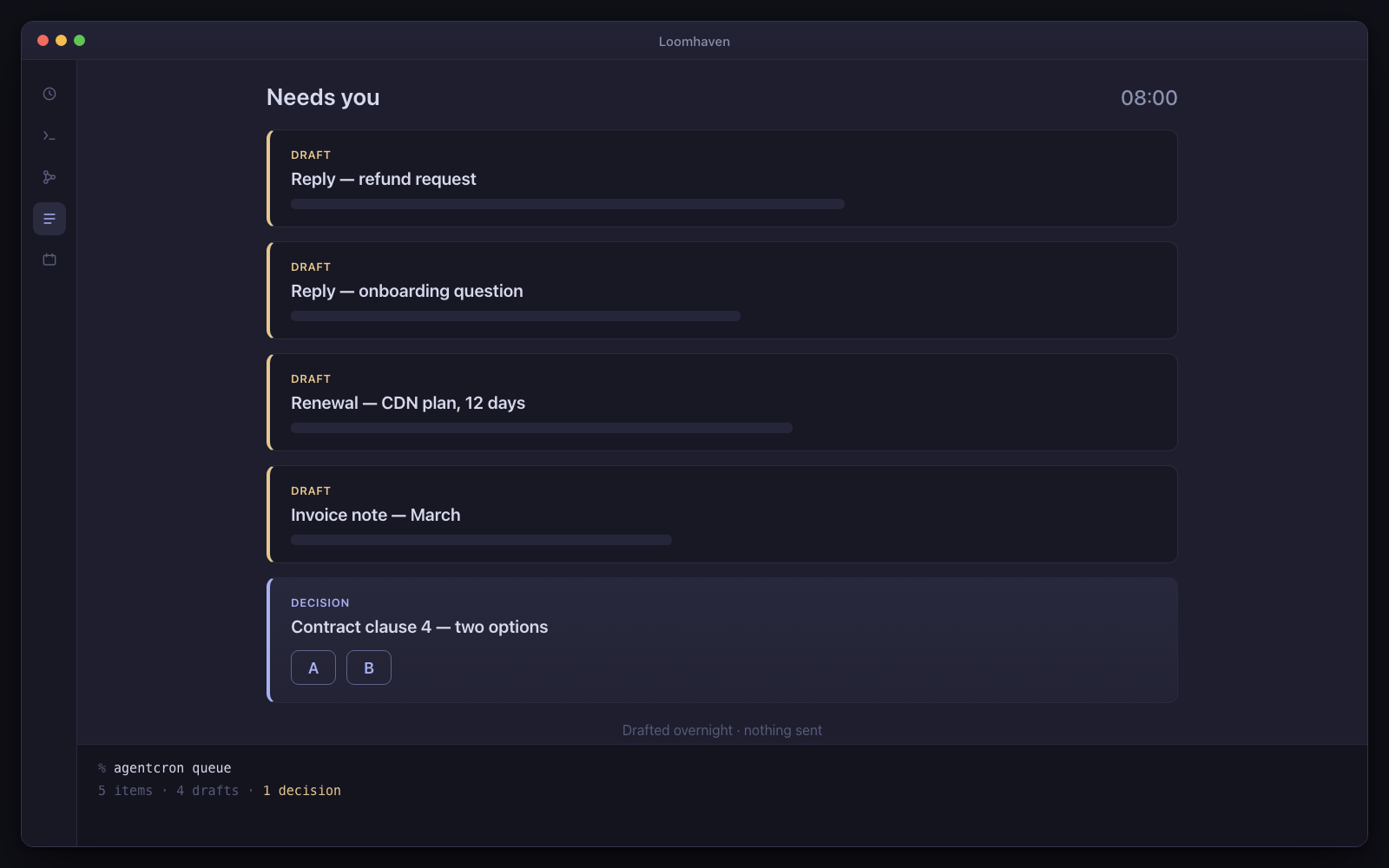
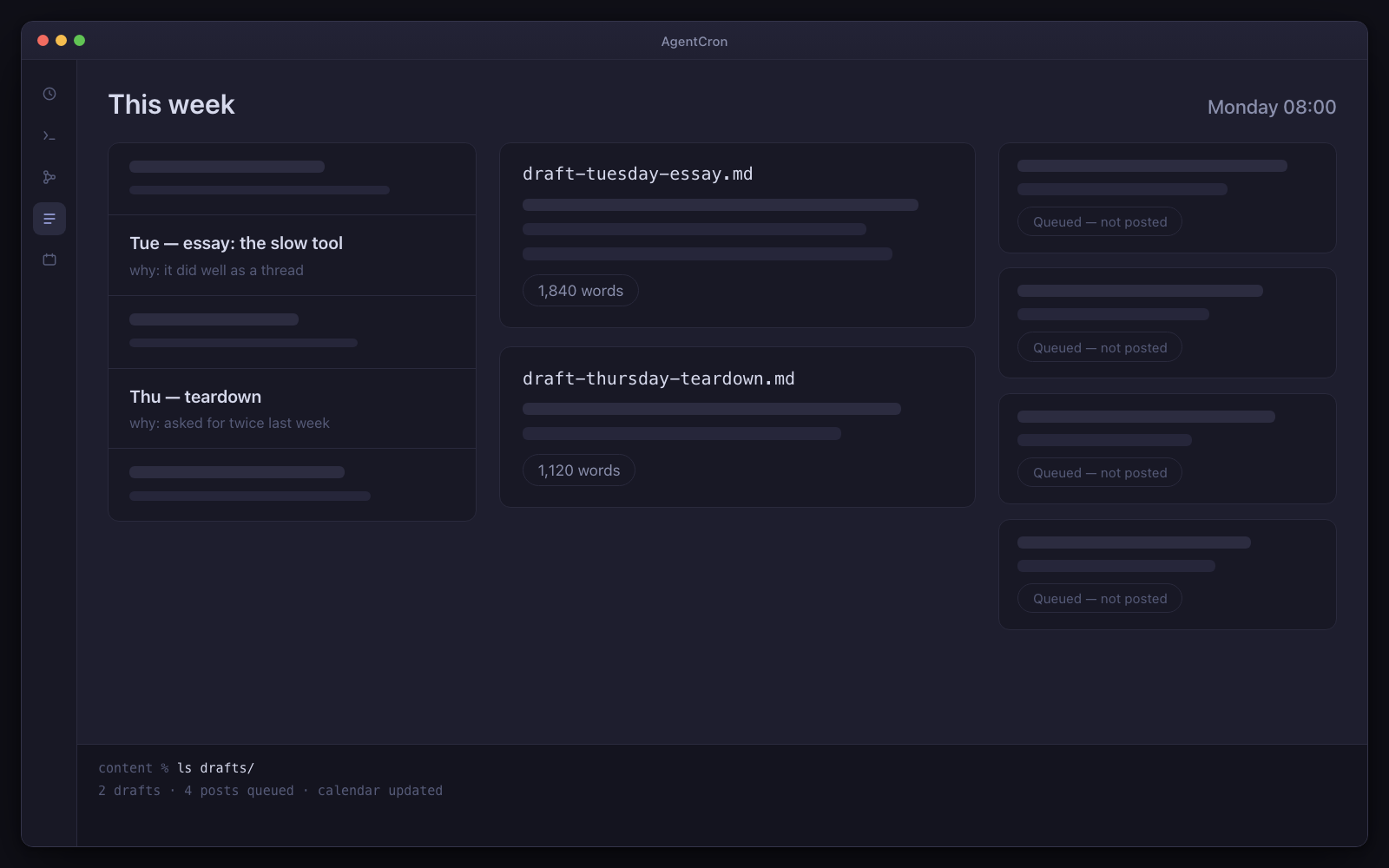
Monday morning in the queue: a week's content calendar with the reasoning beside each slot, two finished drafts underneath it, and the week's social posts lined up as items.
Illustration Monday 08:00. A week planned with the reasoning attached, two finished drafts, and the posts lined up — every one of them waiting on you to publish.

The caveat, up front. It plans and it writes — ideas, outlines, scripts, descriptions, the whole calendar. Rendering and publishing stay with you, which is why nothing goes out in your name that you have not read.

Day one: three agents, already written

  • Content planner

    Mondays at 8am

    A living content calendar driven by your goals and by what is actually working, with the reasoning beside each slot.

  • Draft writer

    Weekday mornings, or on demand

    A brief becomes a finished, on-voice first draft ready for your polish.

  • Social scheduler

    Fridays at 10am

    The week's posts lined up as ready-to-publish drafts on a clear calendar — queued, never posted.

All three are ready-made prompts in the agent picker, switched off until you turn them on. Every agent arrives switched off, with a “Run once” button — nothing fires on its own.

What has to be true first

  • Somewhere for the content project to live: a folder or a repo the agent can read and write
  • Something for the planner to learn from — past pieces, a goals note, or your own numbers pasted in

And the limits, in the same breath

  • macOS only. You bring, install and authenticate one of the supported agent CLIs shown above.
  • Schedules fire while your Mac is awake — AgentCron can hold it awake through a window you set (lid open) — and there is no daemon, no wake-from-sleep and no catch-up for a run that was missed.
  • AgentCron grants none of its own commit, push, send or pay paths by default. The launched CLI remains a real networked process, so separately configured CLI tools and project credentials keep their own risk.
The blank week

Nothing dramatic happens. You have a busy fortnight, the calendar goes empty, and by the time you look up the cadence is gone and starting again is harder than continuing was.

The fix is not more ideas. It is that the planning and the first draft — the two jobs that require a running start and a clear hour — get done before you sit down, so what is in front of you on Monday is something to edit rather than a blank page and a decision about what to make.

Three scheduled agents do that. The calendar arrives planned with the reasoning beside each slot. The briefs arrive as finished first drafts in your voice. The week's posts arrive lined up. Every one of them lands in the queue as an item you open, change and use.

The three agents, and what each one hands you

All three are ready-made prompts in the app, already written and already tuned. Read every word before you switch one on.

  • Content planner — a calendar driven by what is working

    Mondays at 08:00. A living calendar built from your goals for the quarter and from what actually performed, not from a list of generic topics. Each slot arrives with the reasoning attached, so you can disagree with it specifically rather than vaguely.

  • Draft writer — a brief becomes a finished first draft

    Weekday mornings. It takes a brief from the calendar and writes a complete, on-voice first draft ready for your polish. It is a first draft, deliberately: the last twenty per cent is yours and always will be.

    On-voice means on the voice you give it. Point it at your existing work and say what to match, or it will sound like nobody.

  • Social scheduler — the week's posts, lined up

    Fridays at 10:00. The week's social posts written as ready-to-publish drafts on a clear calendar, built from the pieces you actually shipped. They land in the queue.

    As drafts. Nothing is posted, scheduled or sent to a platform — no platform API is touched and none is bundled.

  • It works in your project, on your machine

    Point a project at the folder or repo where your content already lives. The agents read what is there — your past work, your notes, your briefs — because a planner with no context produces a calendar you throw away.

  • It asks instead of guessing

    When a brief is ambiguous in a way that changes the piece, an agent can ask with options and block until you answer, in the app or from your phone. A held draft costs an hour; a confidently wrong one costs the piece.

  • Everything is a file you own

    Each deliverable is a markdown item with its sources in the frontmatter, in your own folder, on your own disk. No account, no cloud, no export step, and nothing that stops working if this app does.

What it writes, and what it does not make

It writes words — plans, briefs, drafts, posts. That is the whole output.

It does not generate video, voice or artwork; no model of any kind ships inside AgentCron and none is bundled. It does not upload, post or schedule to YouTube or any other platform — no platform API is touched, and publishing stays your step for exactly the same reason sending stays your step everywhere else in this product.

If what you wanted was something that makes the video, this is the wrong tool and there is no future version of it that becomes that.

Fair questions

Will the drafts actually sound like me?

Only if you give it something to be on-voice from. Point the project at your existing work and put your voice rules in the prompt — the prompt is yours to edit and that is where the first week's effort goes.

The honest version: the planner and the post drafts hold up well because they are structural work. The long-form draft is a genuine first draft, and the last twenty per cent is yours. If you were hoping to publish it untouched, you will be disappointed, and it is better to know that here.

Can it look at my search or keyword data?

There is an SEO template in the app, and it needs a search-data source — Ahrefs, Semrush or Search Console — reachable over an MCP server you run yourself. None is bundled, none is endorsed and none has been tested here, which is why it is not one of the three agents above.

Can it watch my production pipeline and tell me when it breaks?

You can point a scheduled agent at your own logs or database and have it file what changed — the engine does that today, and durable memory means it can compare against what it saw last week. What does not exist is a ready-made agent for it, so that one is a prompt you would write yourself.

The three above are the ones that ship written.

Which agent CLI does this use?

Whichever you already pay for. Claude Code, GitHub Copilot CLI and agy (Antigravity) are all supported, each launched with the right flags for an unattended run. AgentCron contains no model of its own — your CLI writes the words, on your subscription.

Not released yet. It will need macOS 12.0 or later on Apple Silicon — and the download page says exactly what is still missing.